

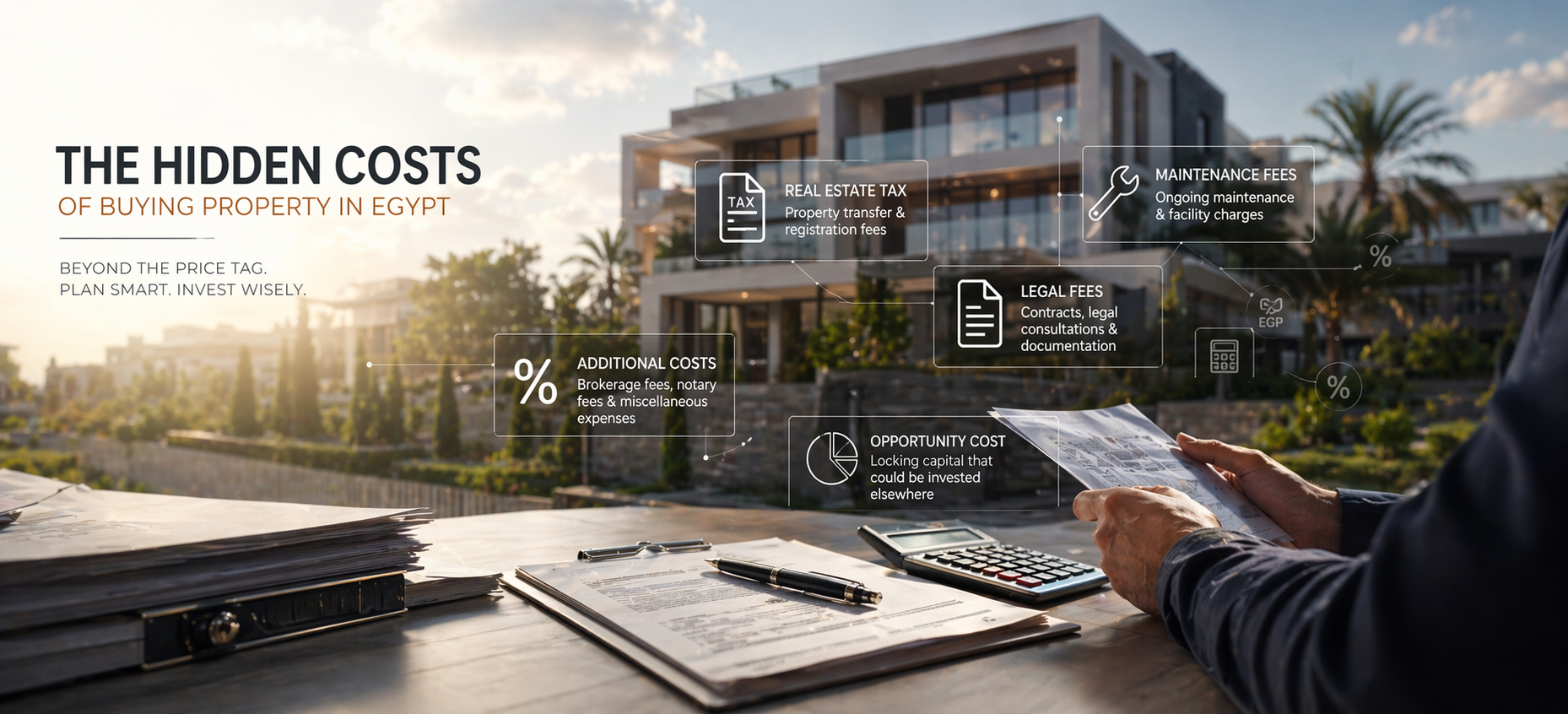
Most property decisions in Egypt start with one number: the price per square meter. It is easy to compare and often treated as the main factor. But it rarely reflects the full financial commitment.
Beyond the listed price, there are additional costs that shape the real investment. Some are expected, like the down payment. Others appear later, including administrative procedures, maintenance fees, and charges tied to newer developments.
This is where many buyers face surprises. What seems straightforward at the beginning can become more complex once these costs start to surface.
Understanding them early allows you to evaluate any property more accurately and avoid unnecessary financial pressure later on.
What Is the True Cost of Property Ownership in Egypt?
The true cost of a property is not limited to its purchase price. It includes every expense required to acquire, prepare, and maintain it over time.
In the Egyptian market, these costs typically fall into three main categories.
-
Upfront Costs
These are the expenses you pay during or shortly after the purchase process. They include more than just the down payment and often involve administrative, legal, and setup-related fees.
-
Ongoing Costs
Once the property is delivered, ownership comes with recurring expenses. Maintenance fees, utilities, and service-related charges become part of the long-term financial commitment.
-
Indirect Costs
These are less visible but equally important. Location, accessibility, and infrastructure can directly impact your monthly spending and overall cost of living.
Looking at property through this structure changes how you evaluate an investment. Instead of focusing only on the entry price, you begin to assess the full financial picture over time.
All the Hidden Costs You Need to Calculate Before Buying
In practice, these cost categories translate into specific expenses that can significantly impact your total investment.
- Administrative and legal costs include contract fees, legal review, and registration procedures.
- Maintenance and service charges cover ongoing community management, security, and shared facilities.
- Finishing costs can be substantial, especially for semi-finished units that require additional work before move-in.
- Payment plan costs reflect the difference between cash and installment pricing, which can increase the total amount paid.
- Location-related costs influence daily expenses such as transportation and accessibility.
Accounting for these costs early allows for a more accurate and realistic evaluation of the property.
Why Hidden Costs Matter More Than the Unit Price
The unit price alone does not reflect the real value of a property.
Two properties with similar pricing can lead to very different total costs once additional expenses are factored in. Finishing requirements, unclear maintenance structures, and location-related costs can all increase the overall financial commitment.
This makes the initial price an incomplete measure. What matters more is how predictable and controlled the total cost is over time.
A property with clearer cost structures and fewer unknowns is often easier to manage financially, even if the starting price is higher.
In this context, the better decision is not defined by the lowest price, but by the level of cost certainty it offers.
The Role of the Developer in Controlling Hidden Costs
Hidden costs are largely shaped by the developer’s decisions across the project lifecycle.
From the beginning, the developer defines how costs are structured. Pricing models, payment plans, and what is included or excluded all influence the total amount paid beyond the unit price.
Planning decisions also affect post-purchase costs. Infrastructure readiness, unit specifications, and finishing standards determine whether buyers will face additional setup or upgrade expenses.
After delivery, the developer’s approach to community management impacts ongoing costs. Maintenance structures, service quality, and operational efficiency all influence how stable these expenses remain over time.
These factors ultimately determine how predictable and manageable the total cost of ownership becomes.
How TBK Developments Reduces Hidden Costs
TBK Developments reduces hidden costs by making pricing clearer, minimizing post-purchase expenses, and stabilizing ongoing costs.
This starts with cost clarity. Buyers can better understand what is included, how payments are structured, and what to expect beyond the unit price, which reduces the likelihood of unexpected charges later.
Planning decisions also influence how much is spent after purchase. When infrastructure is ready and unit specifications are well defined, the need for additional setup or extensive finishing is reduced.
Ongoing costs are shaped by how the community is managed. A structured approach to maintenance and operations helps keep expenses more consistent over time, rather than fluctuating unexpectedly.
When these elements are aligned, the result is a more controlled ownership experience, where costs are easier to anticipate and manage from the beginning.
Make a More Informed Property Investment Decision
A well-informed property decision is not just about comparing prices. It is about choosing a development where costs are clear, planning is intentional, and the ownership experience is predictable over time.
This is where working with the right developer makes a measurable difference. Developments that prioritize transparency, structured planning, and long-term efficiency allow buyers to move forward with greater confidence and fewer uncertainties.
At TBK Developments, this approach is reflected in how projects are designed, priced, and managed, giving buyers a clearer view of their investment from the start.
Experience a more structured and transparent approach to property ownership with TBK Developments.